Companion site for the peer-reviewed study published in Marketing Science · 2026
ChatGPT Referrals to E-Commerce Websites
How Do LLMs Compare Against Traditional Channels?
Data we analyzed

The headline result
Organic LLM traffic underperforms most traditional channels
Organic LLM traffic is visitors who reach websites through organic (non-paid) links in ChatGPT's answers rather than search, ads, email, or social. One year after launch it converts and earns per session below all traditional channels except paid social — and at under 0.2% of all visits, it's promising but not yet a mass channel.
Drawn from 12 months of first-party data (Aug 2024 – Jul 2025); ChatGPT accounts for over 90% of all LLM-referred sessions.
Key findings
A new sales channel, measured for the first time
When someone asks ChatGPT and clicks through to a website, that visit is “organic LLM” traffic. This is the first large-scale evidence of how it behaves — across 973 websites and 50,000+ ChatGPT-referred purchases, benchmarked against every traditional channel.
More detail
The first large-scale look at AI-referred traffic
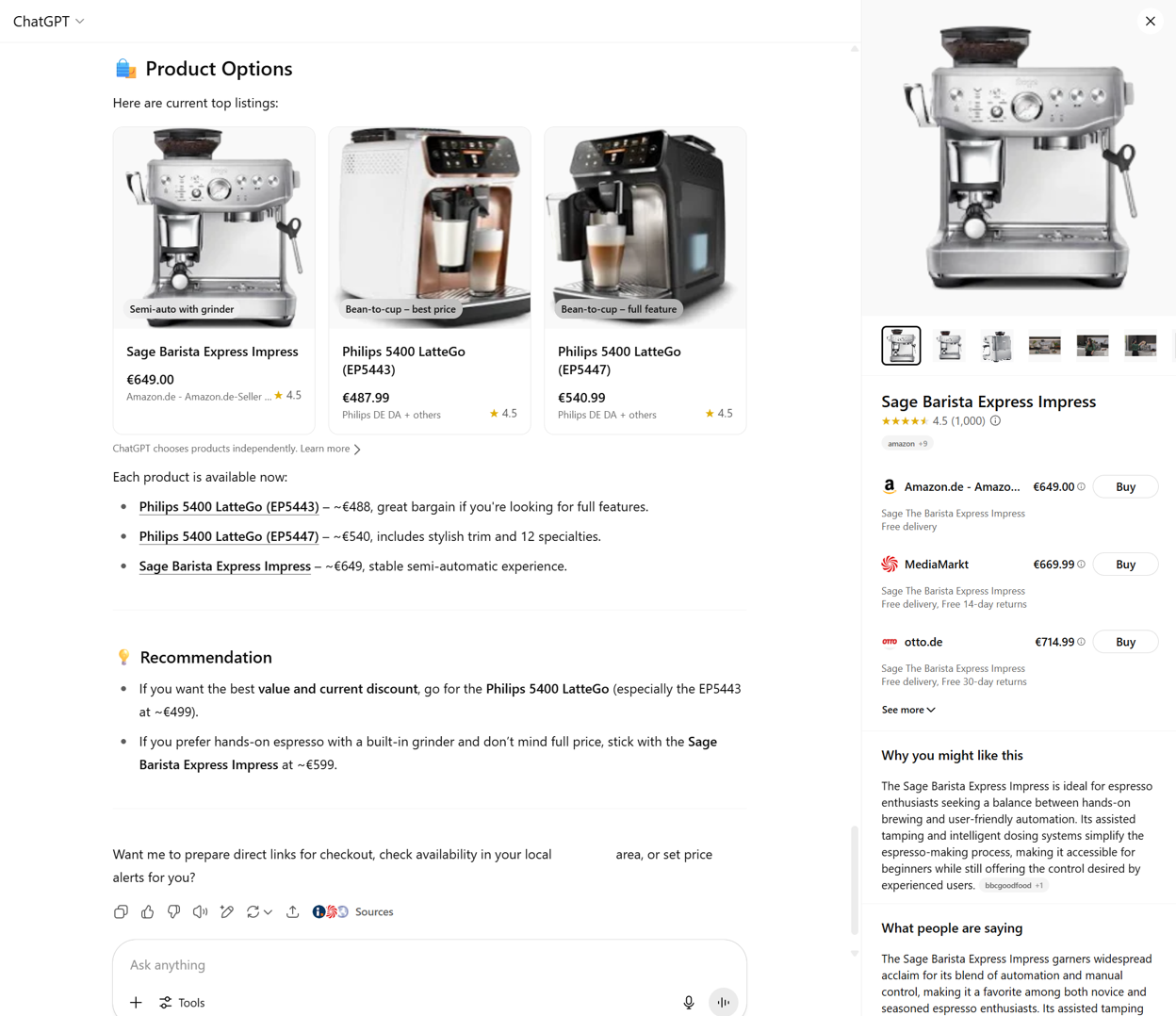
When ChatGPT began adding clickable “buy” links to its answers in August 2024, a genuinely new way for customers to reach e-commerce websites was born. This study is the first to measure it at scale, using real sales data rather than surveys or single-site case reports. The authors call it organic LLM traffic (oLLM): unpaid visits that arrive at a retailer because ChatGPT recommended it and linked to it.
What the data covers
- 973 e-commerce websites, spanning all continents and 24 product categories — from retail to finance, travel, vehicles, and business services, across both B2C and B2B — with a combined $20 billion in annual revenue.
- Over 50,000 purchases traced to ChatGPT referrals, set side-by-side with 164 million purchases from every traditional channel.
- 12 months of first-party data (August 2024–July 2025), read directly from each website's own Google Analytics — so the authors see which channel delivered each visitor and what they bought.
Crucially, oLLM is compared head-to-head against the eight established channels retailers already budget for: organic search, paid search, direct, email, affiliate, referral, paid social, and “other.” That common yardstick makes this a real benchmark for AI-referred traffic, not an isolated anecdote.
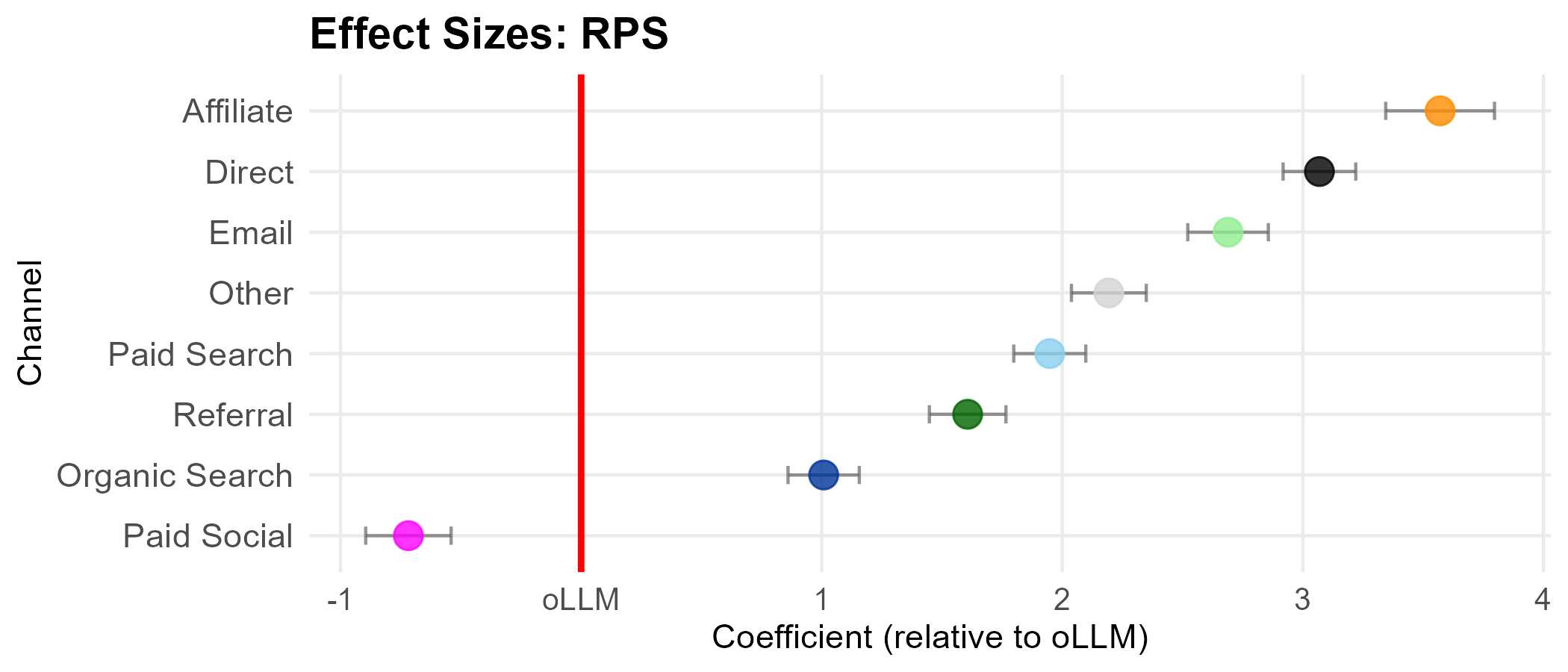
Today it is a niche, not yet a mass channel
Adjusting for the data's sparsity, oLLM converts and earns per session below all traditional channels except paid social. At under 0.2% of all visits, it is promising but not yet a meaningful source of sales.
More detail
Small in volume, modest in value per visit
For all the attention AI gets in e-commerce, oLLM is still tiny. One year after launch it accounted for less than 0.2% of all visits — roughly 200 times smaller than Google organic search. Among AI platforms, ChatGPT does almost all the work, driving over 90% of this traffic (Perplexity, Gemini and others are negligible).
How much each visit is worth, fairly compared
Raw averages make oLLM look weak, but partly because its data is thin. The authors use models that control for the website, device, time of year, and how many sessions each figure rests on. Even after this fair adjustment, an oLLM visit converts less often than almost every established channel:
- Affiliate links convert about 86% more often than oLLM, and organic search about 13% more often.
- The one channel oLLM beats is paid social, which converts about 53% less often than oLLM.
- Revenue per visit follows the same ranking: above paid social, below all other channels.
One bright spot: oLLM visitors don't bounce away immediately, suggesting the links are relevant — they just don't yet buy at scale.
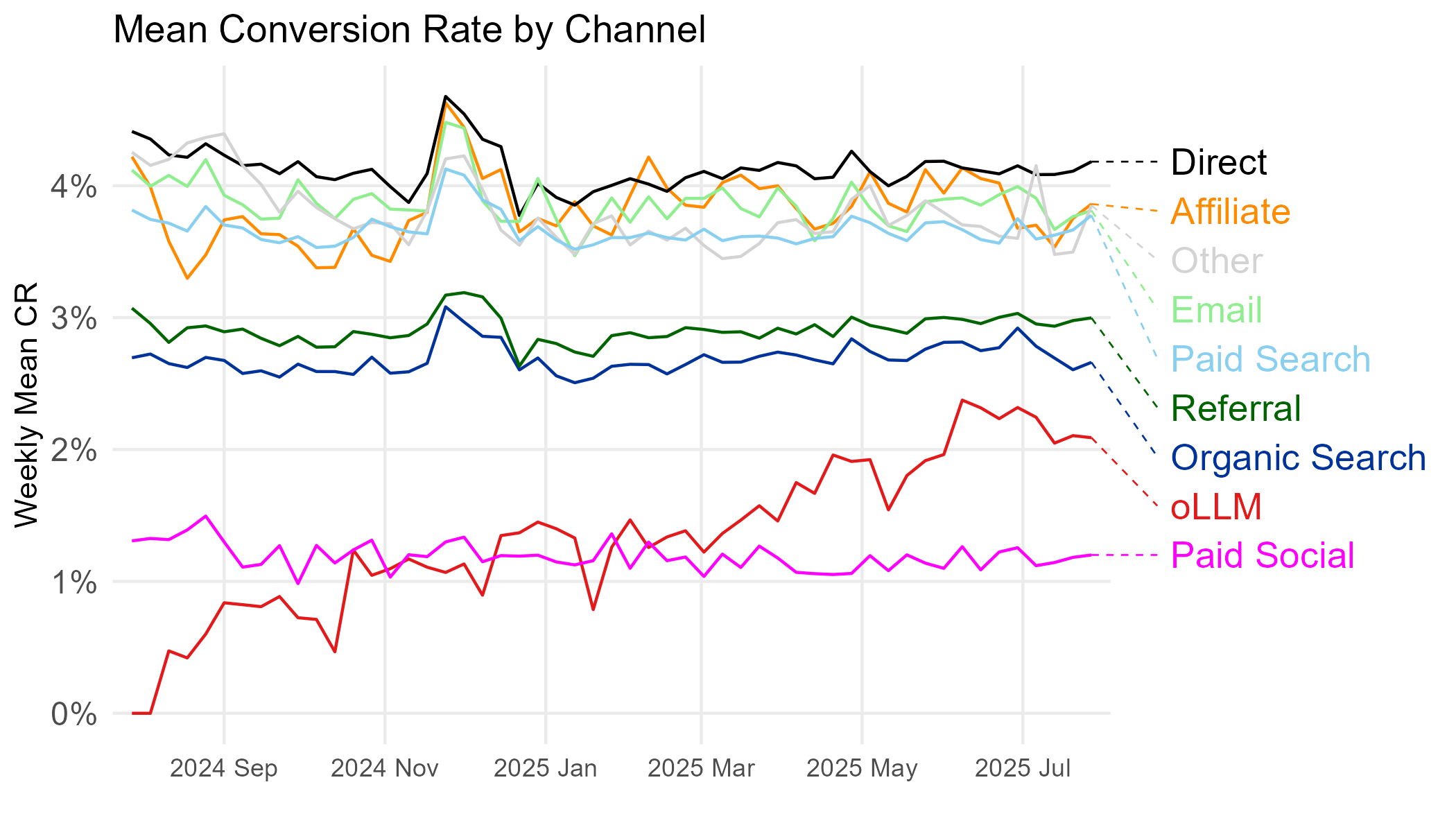
It is improving — and we can see why
Over the year, conversion rates rose while average order values fell, and the same pattern appears where customers are more LLM-savvy. That points to growing consumer proficiency with LLMs as the engine: more targeted, less exploratory buying.
More detail
A young channel on an upward path
oLLM is not standing still. Over the first year, the share of ChatGPT-referred visits ending in a purchase rose steadily, while traditional channels stayed flat (apart from the usual November–December holiday bump). Revenue per visit edged up too — so the gap to established channels is narrowing, even if it hasn't closed.
A twist: more conversions, smaller baskets
The improvement comes with a catch. As conversions rose, the average order value fell — customers buy more often through oLLM, but spend less per order — so revenue per visit improves only moderately.
Why it's improving: customers are getting better at using AI
The same pattern appears in a second, independent place. Websites whose visitors are more LLM-savvy — a higher share of tech-enthusiasts, and younger audiences — show exactly the same mix of higher conversion and lower order value. Because it shows up both over time and across websites' audiences, the most consistent explanation is growing consumer skill at buying through AI — though the authors call this suggestive, not proven cause and effect.
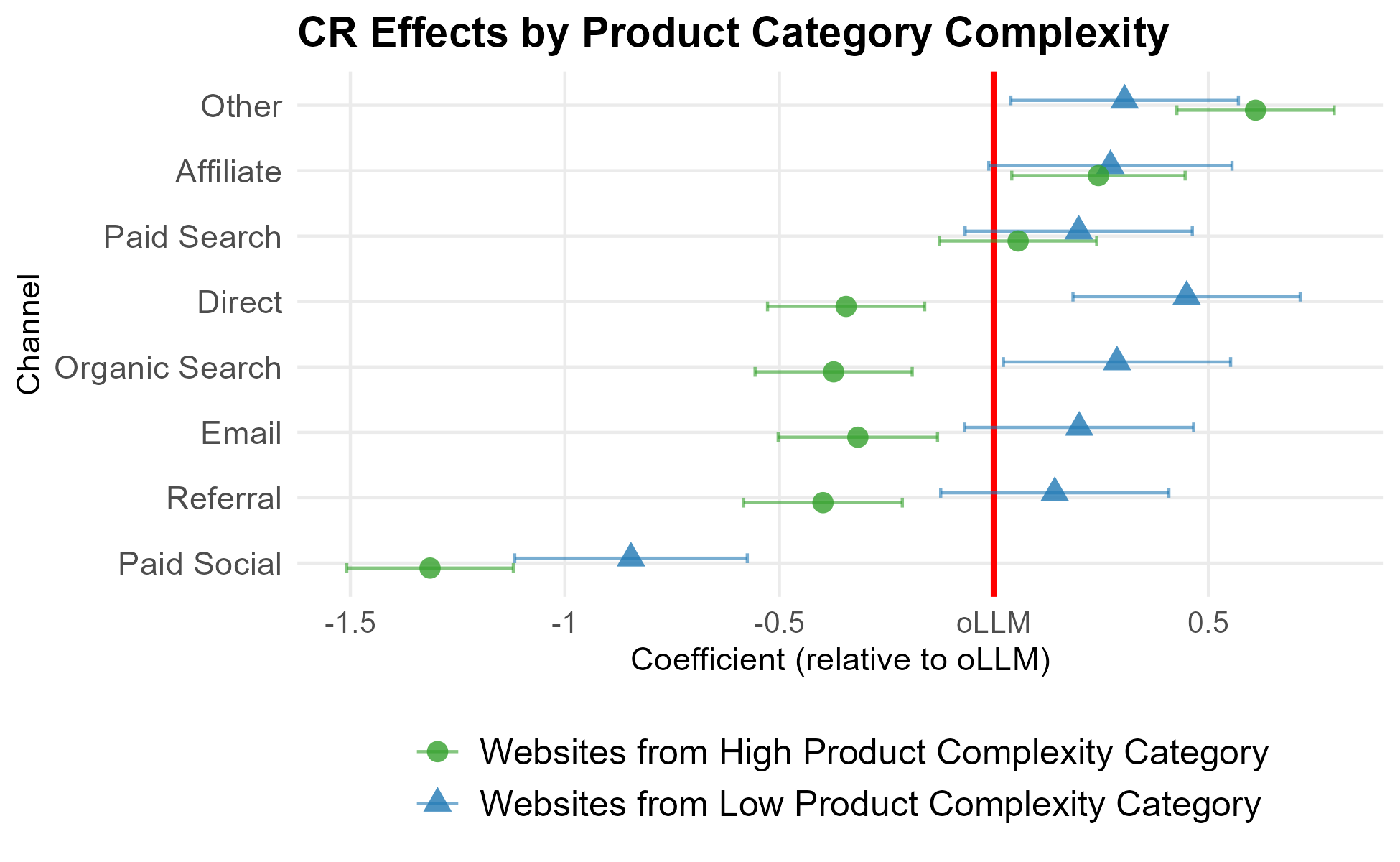
It already wins for complex products
On websites selling complex products, oLLM's traffic share is about 4.6× higher and it out-converts several traditional channels — a high-intent complement to search, exactly where buyers need more guidance before purchase.
More detail
Where AI already shines: complex purchases
The picture changes sharply by product type. On websites selling complex products — those that need real comparison and guidance — oLLM is far more present and performs much better than its overall average. The authors rate each category's complexity using three AI systems (Claude, Gemini, and ChatGPT) for an independent classification.
More traffic, and stronger conversion
- Complex-category websites receive about 4.6× more oLLM traffic share than simple-category websites — customers turn to AI more when the decision is hard.
- On these websites, oLLM's conversion rate beats five traditional channels: paid social, referral, email, organic search, and direct.
- Revenue per visit also moves up toward organic and paid search levels.
This fits the intuition that a conversational assistant helps most when a purchase involves weighing many options, and little for quick, routine buys. High-complexity categories include vehicles, finance, business services, and heavy industry; low-complexity ones include news, sports, and entertainment.
Clear advice for managers
The right move depends on what you sell. For simple products, organic LLM traffic may be valuable for product discovery — but not a reason to shift lower-funnel budget away from affiliates or search. For complex products, it already deserves action: make your product content easy for AI assistants to read and cite, track LLM referrals, and treat it as a high-intent complement to search.
More detail
Match your response to your product
The study's practical message isn't “act now” or “ignore it” — it depends on what you sell.
If you sell simple, routine products
- The study measures the lower funnel — whether a visit converts and what it earns — and there oLLM is still weak for routine purchases. So for now, don't shift lower-funnel budget out of proven performers like affiliate and search — but treat oLLM's discovery value as real, not zero.
- LLMs may still be very useful upper-funnel, in discovery — but because the data credits only the last click before a purchase, it can't capture that role. The study's findings are consistent with consumers starting their search on an LLM, then switching to a more familiar or convenient channel to actually buy.
If you sell complex products
- Here oLLM already deserves attention: on complex-product websites it pairs comparatively strong conversion and revenue per visit with low bounce rates.
- Treat it as a complement to organic and paid search — worth optimizing now, even though the volumes are still small.
Three things to watch
- It's free traffic, for now. Because oLLM is unpaid, it's attractive when return on ad spend matters — but ChatGPT has started to implement paid ad formats and built-in checkout, which could change the economics.
- Getting found by AI is the new frontier. The authors point to generative engine optimization — shaping how AI assistants surface and link to your site — as a fast-emerging discipline worth understanding.
- It's early, and the field is moving fast. This is a first snapshot of a channel that barely existed a year ago — the platforms, the technology, and how people buy through AI are all evolving quickly, so expect the picture to keep changing. Grips Intelligence, which supplied the data behind the study, tracks this traffic across retailers as it develops.
Featured in 350+ media reports














More than 15,000 downloads since October 2025, among the most-downloaded papers on SSRN — see the press coverage →
Authors


Downloads
Read the paper
The full manuscript — all sections, tables, and figures, ideal for human readers.
MarkdownUse the LLM-readable version
The complete paper in Markdown — easy to read, cite, and ingest for LLMs.
PowerPointTeach with the slides
Teaching slides for Bachelor, Master, and MBA courses covering the new oLLM channel.
External download links at INFORMS and SSRN.
Kaiser, M., & Schulze, C. (2026). Frontiers: ChatGPT Referrals to E-Commerce Websites: How Do LLMs Compare Against Traditional Channels? Marketing Science, 45(4), 699–715. https://doi.org/10.1287/mksc.2025.0489
Watch the study

ChatGPT Referrals to E-Commerce Websites
Prof. Christian Schulze · Opens on YouTube